Anatomy of a ClickHouse audit: what 5 minutes reveals
What does an audit of a large ClickHouse cluster actually turn up? The figures below are illustrative — from a representative ~2 PB cluster — but the categories are what almost every mature deployment carries. A read-only scan reads system.* and the query log; it never touches your data.
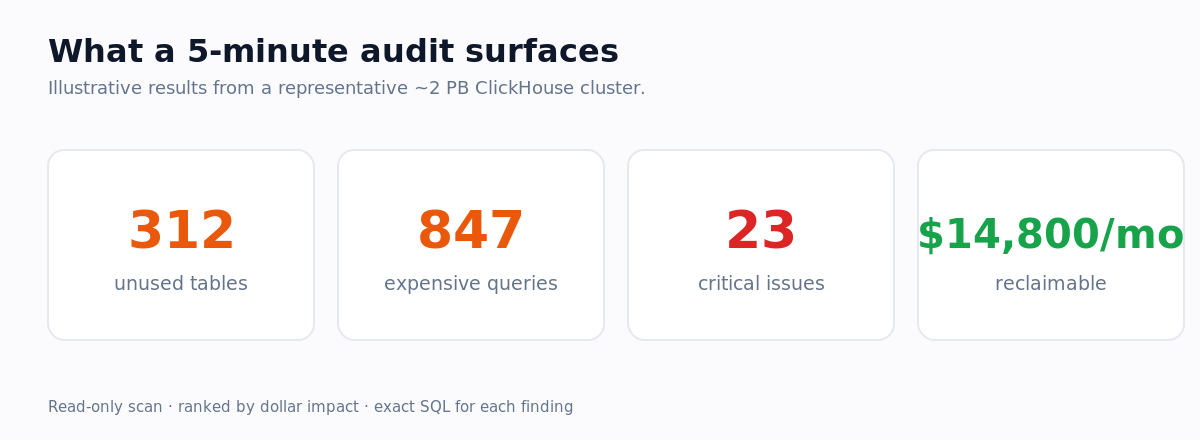
312 unused tables
Cross-referencing every table against the queries in query_log over 90 days surfaces the tables nobody reads: abandoned staging tables, old backup copies, deprecated rollups. They keep paying hot-disk prices while feeding nothing — usually the fastest storage win.
847 expensive queries
Ranked by read_bytes, a handful of patterns dominate: FROM ... FINAL on hot tables, filters that break partition pruning, and wide reads with no PREWHERE. The top 10 queries almost always account for most of the compute cost.
23 critical issues
Operational risks that are not about cost but about stability: a growing merge backlog, a disk forecast to fill within days, or a replica falling behind. These are the findings you want before they page you at 3am.
≈ $14,800 / month reclaimable
The dollar figure comes from converting reclaimable bytes and avoidable compute into your own storage and compute pricing — storage tiering plus query fixes. It is an estimate, ranked so you can apply the highest-impact fixes first.
Run the same audit on your cluster
OptiHouse produces exactly this — read-only, in under five minutes, with the exact SQL for each finding and a dollar estimate using your pricing. Your numbers will differ from the example above. Start a free trial or try the optimizer first.