ClickHouse cost optimization: a practical checklist
June 14, 2026·5 min read
#ClickHouse#cost#checklist#FinOps
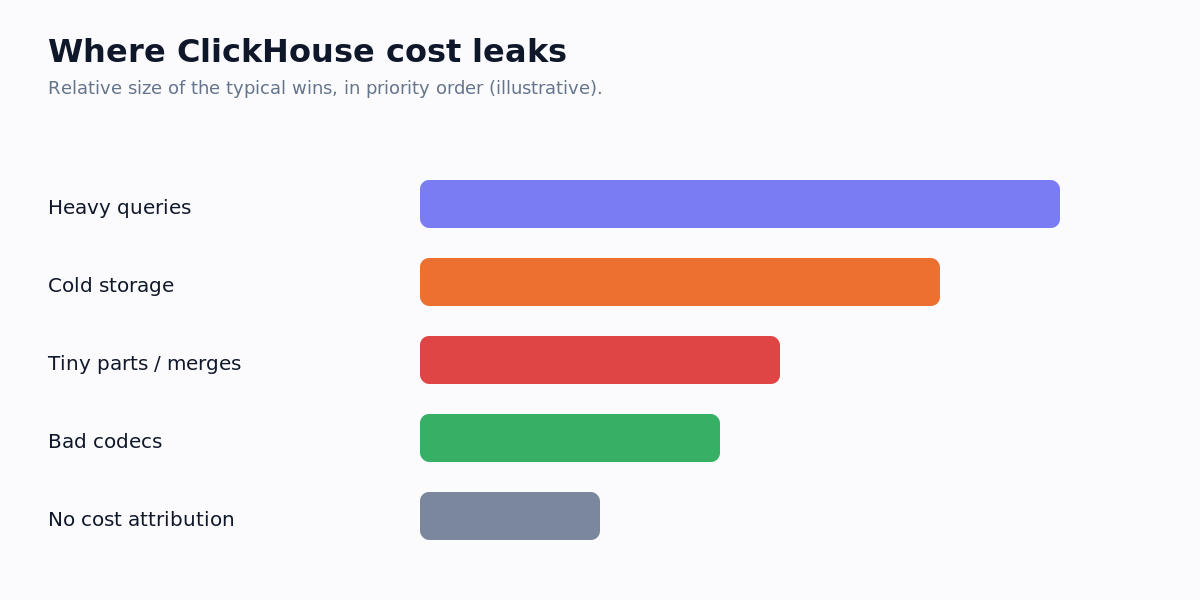
If your ClickHouse bill keeps climbing, the waste is almost always in one of five places. Work through this checklist in order — the first two usually deliver most of the savings.
Compute: tune the heaviest queries
- Rank queries by
read_bytesinsystem.query_log— the top 10 usually dominate cost. - Fix broken partition pruning (no functions on the partition key).
- Add
PREWHEREon selective filters over wide tables. - Replace
FROM ... FINALon hot paths withargMax/LIMIT 1 BY.
Storage: reclaim what nobody reads
- Find the biggest tables in
system.parts. - Drop or archive tables not touched in 90+ days.
- Move cold partitions to object storage with a TTL
TO VOLUMErule. - Delete zombie materialized views that feed nothing.
Part hygiene: stop the merge tax
- Flag tables with thousands of tiny parts in
system.parts. - Batch inserts (or enable
async_insert) to produce fewer, larger parts. - Watch the merge backlog in
system.mergesand replica lag insystem.replicas.
Schema: store fewer bytes
- Apply per-column codecs (
Delta, ZSTD,Gorilla, ZSTD,T64). - Wrap low-distinct string columns in
LowCardinality. - Add skipping indexes for frequent non-PK filters.
- Order the primary key by lowest-cardinality columns you filter on most.
Attribution: know who spends what
Group query_log by user to build a simple chargeback of read volume per team or service. You cannot control spend you cannot attribute.
The whole checklist, automated
OptiHouse runs every item above on a read-only scan, ranks the findings by dollar impact, and ships each with the exact SQL. Start free or try the optimizer — and see the deep-dives in our playbooks.Read also
Anatomy of a ClickHouse bill: finding $14,800/month of waste in one read-only scan
A transparent teardown of a representative 2.4 PB ClickHouse cluster — FINAL on every read, missing PREWHERE, weak codecs, zombie materialized views — and the exact SQL to reclaim ~$14,800/month, read-only.
ClickHouse cost optimization: a complete guide to cutting your bill
Where ClickHouse spend actually goes — compute on bad queries, storage on cold data, parts and merge overhead — and the exact SQL to reclaim 20–40% of it, read-only and risk-free.
5 kinds of unused tables hiding in your ClickHouse
Most ClickHouse clusters carry tables nobody reads anymore — abandoned staging, zombie materialized views, backups, deprecated rollups. Here's how to find them and what they cost.