Too many parts in ClickHouse: causes and fixes
ClickHouse stores every insert as a part and merges parts in the background. When inserts arrive too small and too often, parts pile up faster than merges can keep up — you get Too many parts errors, throttled inserts, and queries that slow down as part counts grow.
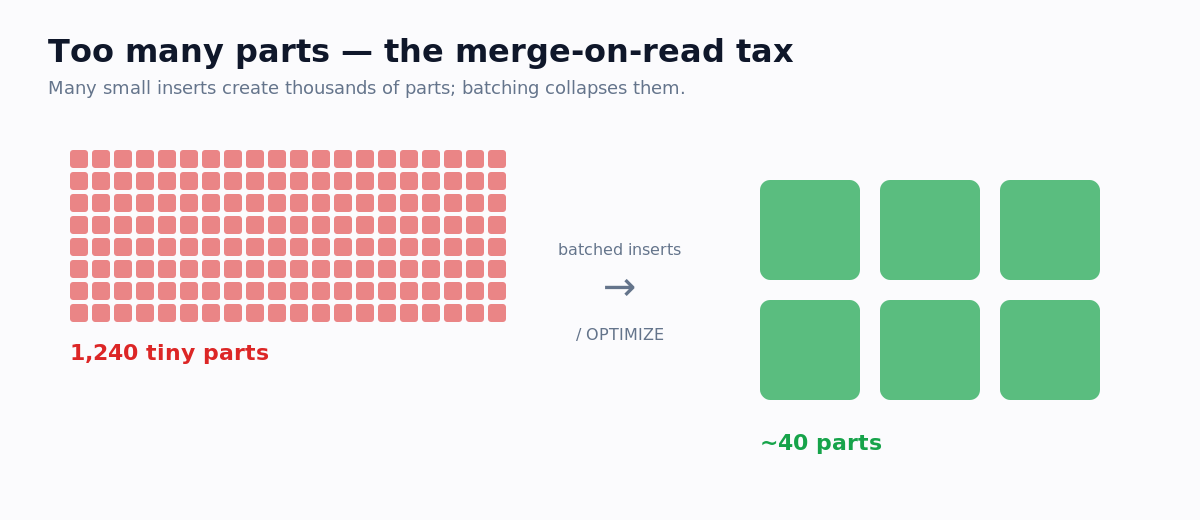
Find the fragmented tables
A healthy MergeTree table holds tens of active parts per partition, not thousands. Rank tables by active part count and watch the average part size — many tiny parts is the tell-tale sign.
SELECT database, table,
       count() AS parts,
       formatReadableSize(avg(bytes_on_disk)) AS avg_part
FROM system.parts
WHERE active
GROUP BY database, table
HAVING parts > 300
ORDER BY parts DESC;
Diagnose insert pressure
Tiny parts come from tiny, frequent inserts. system.part_log records each part as it is created — a high rate of small new parts means the writer is inserting row-by-row instead of in batches.
async_insert = 1 so ClickHouse buffers small inserts server-side. Both produce fewer, larger parts and collapse merge debt at the source.When to force a merge
OPTIMIZE TABLE ... FINAL merges parts on demand, but it is heavy — run it off-peak and only as a one-time cleanup, not on a schedule. Fixing the insert pattern is the real solution.
Catch it automatically
OptiHouse flags fragmented tables, insert pressure and merge debt on every read-only scan, each with a runbook. Start free or try the optimizer.